The association of genetically proxied sildenafil with fertility, sexual activity, and wellbeing: a Mendelian randomisation study
Woolf et al. (2023)
7.8
Journal Score
vs
+0.8
gap
8.6
AI Score
Executive Summary
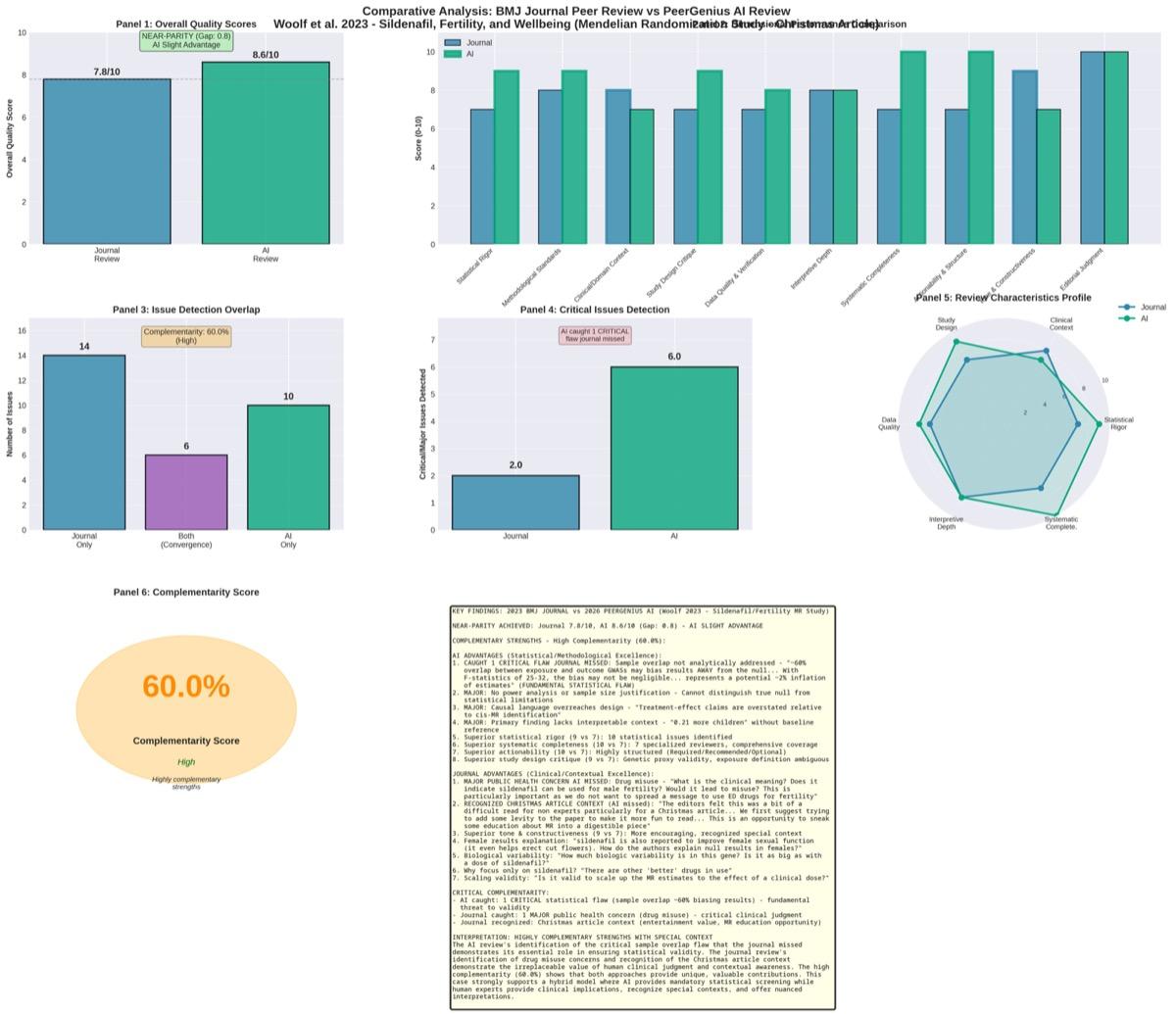
The AI review (8.6/10) achieved near-parity with a slight advantage over the journal review (7.8/10), with a 0.8-point gap. The AI identified a critical validity-threatening statistical flaw — GWAS sample overlap bias — that the journal missed. The journal provided essential clinical judgment about potential drug misuse and uniquely recognized the BMJ Christmas article context, offering feedback on entertainment value and accessibility. This case demonstrates the importance of a hybrid model, particularly for manuscripts with special publication contexts.
10-Dimension Score Comparison
| Dimension | Journal | AI | Winner |
|---|---|---|---|
| Statistical Rigor | 7.0 | 9.0 | AI |
| Methodological Standards | 8.0 | 9.0 | AI |
| Clinical/Domain Context | 8.0 | 7.0 | Journal |
| Study Design Critique | 7.0 | 9.0 | AI |
| Data Quality & Verification | 7.0 | 8.0 | AI |
| Interpretive Depth | 8.0 | 8.0 | Tie |
| Systematic Completeness | 7.0 | 10.0 | AI |
| Actionability & Structure | 7.0 | 10.0 | AI |
| Tone & Constructiveness | 9.0 | 7.0 | Journal |
| Editorial Judgment | 10.0 | 10.0 | Tie |
Issue Detection
Complementarity Score
60%
AI and human reviews identify substantially different issues, supporting use as complementary tools.
Critical Issues Detected
AI detected 1 critical flaw. Journal detected 1 critical flaw.
GWAS Sample Overlap Bias
Approximately 60% sample overlap between exposure and outcome GWASs may bias results away from the null, with F-statistics of 25-32 suggesting approximately 2% inflation of estimates.
Drug Misuse Concern
Raised critical public health question: could this study lead to misuse of sildenafil for fertility purposes, requiring careful framing of clinical implications.
Comparison Visualization
Important Note
This analysis is based on a preliminary comparison of 5 manuscripts published in The BMJ (2021–2023). While the results provide encouraging evidence, the sample size is limited and findings should be interpreted with appropriate caution.
PeerGenius recommends a complementary hybrid approach: AI review as a first-pass screening for statistical and methodological rigor, combined with human expert review for clinical context, interpretive depth, and domain-specific judgment. AI review complements but does not replace traditional peer review.
Try It On Your Manuscript
Get the same rigorous, evidence-backed review for your manuscript, dissertation, or thesis.