Impact of abolishing primary care financial incentives on quality-of-care in Scotland
Morales et al. (2022)
7.8
Journal Score
vs
+0.3
gap
8.1
AI Score
Executive Summary
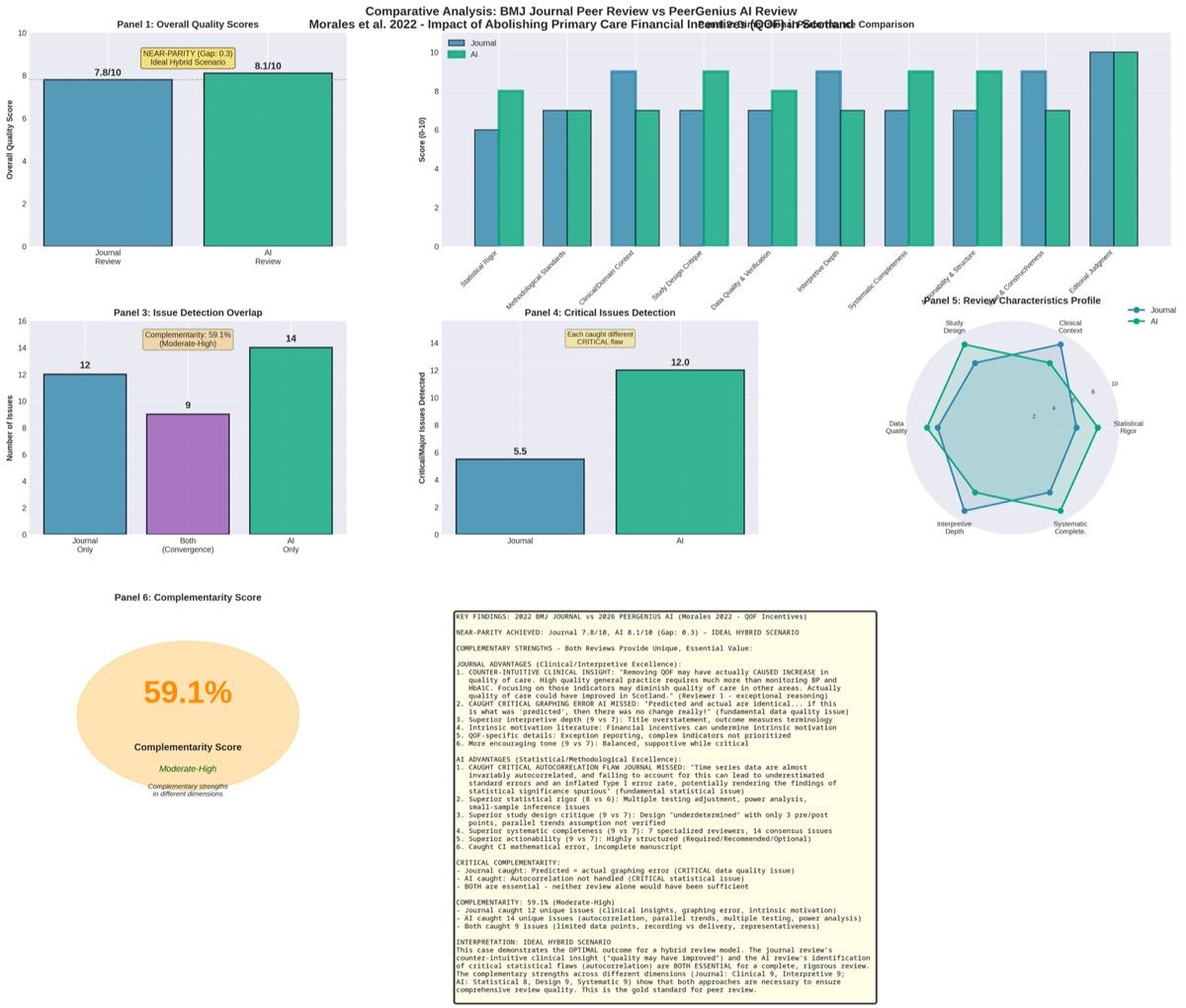
This case represents the ideal outcome for a hybrid review model: near-parity (0.3-point gap) with highly complementary strengths. The most important finding is that each review caught a different critical, validity-threatening flaw the other missed. The journal found a fundamental data/graphing error (predicted and actual values identical), while the AI found a critical statistical omission (autocorrelation handling). Neither review alone was complete; together they create an exceptionally rigorous evaluation — a compelling case for combined AI and human review.
10-Dimension Score Comparison
| Dimension | Journal | AI | Winner |
|---|---|---|---|
| Statistical Rigor | 6.0 | 8.0 | AI |
| Methodological Standards | N/A | N/A | — |
| Clinical/Domain Context | 9.0 | 7.0 | Journal |
| Study Design Critique | 7.0 | 9.0 | AI |
| Data Quality & Verification | N/A | N/A | — |
| Interpretive Depth | 9.0 | 7.0 | Journal |
| Systematic Completeness | 7.0 | 9.0 | AI |
| Actionability & Structure | 7.0 | 9.0 | AI |
| Tone & Constructiveness | 9.0 | 7.0 | Journal |
| Editorial Judgment | N/A | N/A | — |
Issue Detection
Complementarity Score
59.1%
AI and human reviews identify substantially different issues, supporting use as complementary tools.
Critical Issues Detected
AI detected 2 critical flaws. Journal detected 1 critical flaw.
Omission of Autocorrelation Handling
Critical statistical flaw in time series analysis: failing to account for autocorrelation leads to underestimated standard errors and inflated Type I error rates.
Underdetermined Study Design
Only 3 pre-intervention and 3 post-intervention data points, severely limiting the ability to establish reliable trends.
Graphing Error — Predicted and Actual Values Identical
Fundamental data quality error: predicted and actual values in a key graph were identical, suggesting a coding or presentation error that undermines the analysis.
Comparison Visualization
Important Note
This analysis is based on a preliminary comparison of 5 manuscripts published in The BMJ (2021–2023). While the results provide encouraging evidence, the sample size is limited and findings should be interpreted with appropriate caution.
PeerGenius recommends a complementary hybrid approach: AI review as a first-pass screening for statistical and methodological rigor, combined with human expert review for clinical context, interpretive depth, and domain-specific judgment. AI review complements but does not replace traditional peer review.
Try It On Your Manuscript
Get the same rigorous, evidence-backed review for your manuscript, dissertation, or thesis.