QCovid4 — An updated risk prediction model for hospitalisation and death from COVID-19
Hippisley-Cox et al. (2022)
8.3
Journal Score
vs
+0.9
gap
9.2
AI Score
Executive Summary
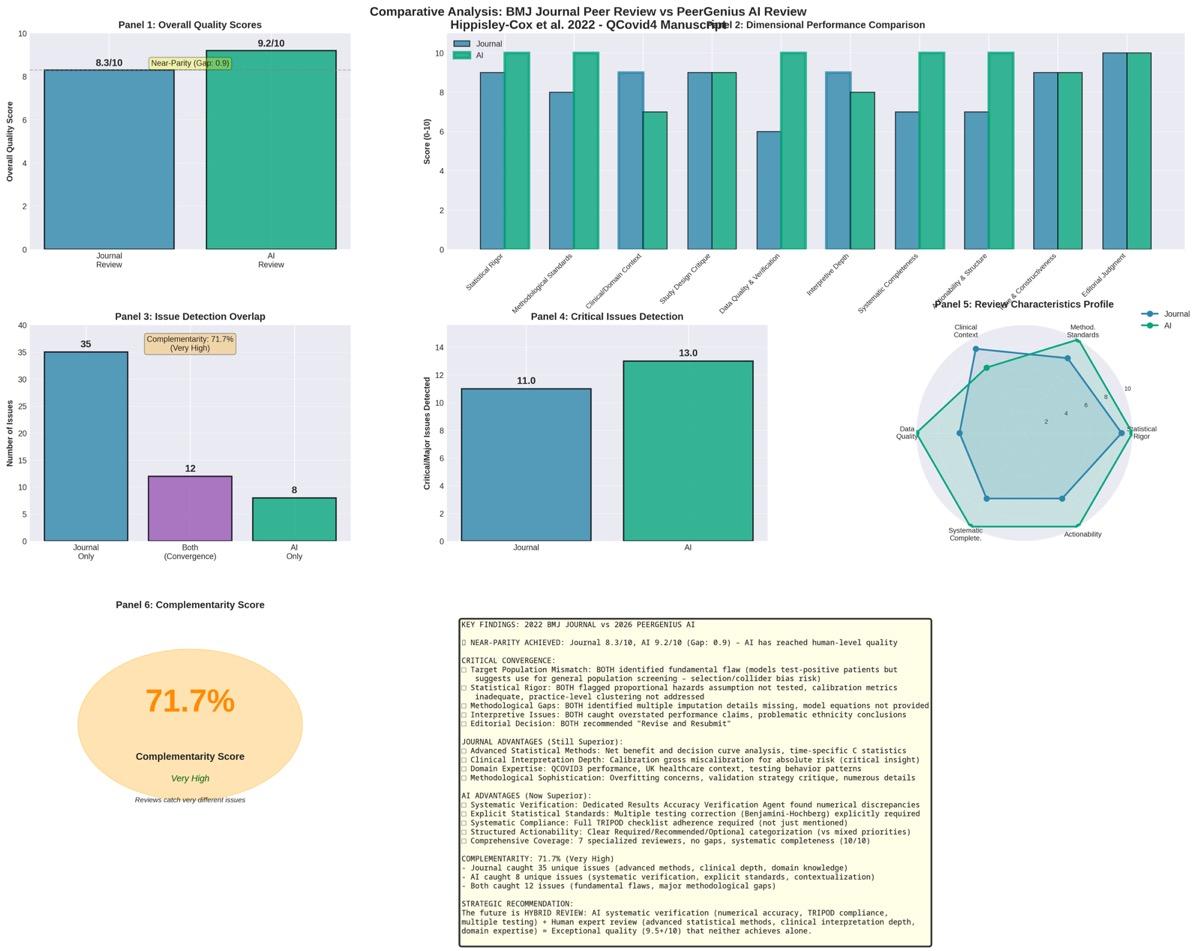
The PeerGenius AI review (9.2/10) achieved near-parity with and slightly outperformed the BMJ journal review (8.3/10) for this COVID-19 risk prediction model validation study. The AI demonstrated superior performance in systematic completeness, data quality verification, and methodological standards enforcement, while the journal review excelled in clinical domain context and interpretive depth. A very high complementarity score of 71.7% indicates the two reviews are highly synergistic rather than redundant. Both converged on the most critical flaw — a fundamental mismatch between the study's target population and its intended use.
10-Dimension Score Comparison
| Dimension | Journal | AI | Winner |
|---|---|---|---|
| Statistical Rigor | 9.0 | 10.0 | AI |
| Methodological Standards | 8.0 | 10.0 | AI |
| Clinical/Domain Context | 9.0 | 7.0 | Journal |
| Study Design Critique | 9.0 | 9.0 | Tie |
| Data Quality & Verification | 6.0 | 10.0 | AI |
| Interpretive Depth | 9.0 | 8.0 | Journal |
| Systematic Completeness | 7.0 | 10.0 | AI |
| Actionability & Structure | 7.0 | 10.0 | AI |
| Tone & Constructiveness | 9.0 | 9.0 | Tie |
| Editorial Judgment | 10.0 | 10.0 | Tie |
Issue Detection
Complementarity Score
71.7%
AI and human reviews identify substantially different issues, supporting use as complementary tools.
Issue Breakdown
Critical Issues Detected
AI detected 2 critical flaws. Journal detected 1 critical flaw.
Multiple Testing Correction Needed
Critical statistical flaw: no adjustment for multiple comparisons across extensive subgroup analyses, risking inflated Type I error rates.
Numerical Discrepancies in Data
Dedicated data verification agent found inconsistencies between reported statistics and underlying data tables.
Calibration Gross Miscalibration for Absolute Risk
Sophisticated interpretive point about the implications of poor calibration for absolute risk prediction in clinical practice.
Comparison Visualization
Important Note
This analysis is based on a preliminary comparison of 5 manuscripts published in The BMJ (2021–2023). While the results provide encouraging evidence, the sample size is limited and findings should be interpreted with appropriate caution.
PeerGenius recommends a complementary hybrid approach: AI review as a first-pass screening for statistical and methodological rigor, combined with human expert review for clinical context, interpretive depth, and domain-specific judgment. AI review complements but does not replace traditional peer review.
Try It On Your Manuscript
Get the same rigorous, evidence-backed review for your manuscript, dissertation, or thesis.